Monaco vs Salesforce Agentforce
Reviewed by MarTechRadar Research Desk. Pricing & entity snapshots verified Oct 10, 2026.
Monaco (Web SaaS, Autonomous Marketing Agents & Digital Coworkers) and Salesforce Agentforce (Web SaaS, Enterprise Marketing OS & Ecosystem Agents) address adjacent GTM workflows. On pricing, Monaco lists $10,000 usage-based (no free plan disclosed), whereas Salesforce Agentforce lists Custom / enterprise pricing (free plan). Technically, Monaco is rated L3 · Conditional automation with a 3.8/5.0 (Proprietary moat) moat, while Salesforce Agentforce is rated L4 · Autonomous agent with a 4.8/5.0 (Proprietary moat (category leader)) moat. Corporate profile: Monaco (founded 2024, HQ San Francisco, California, $85M funding) vs. Salesforce Agentforce (founded 1999, HQ San Francisco, United States). Verified by the MarTechRadar Research Desk (Oct 10, 2026 for Monaco; Oct 7, 2026 for Salesforce Agentforce). At a 5-seat team baseline, Monaco starts at ~$50,000/mo vs Salesforce Agentforce at Custom quote.
Monaco
Autonomous revenue engine executing multi-agent outbound pipeline generation and prospect discovery for early-stage commercial teams.
5-Seat Floor: ~$50,000/mo ($10,000 usage-based) · Autonomy: L3 · Conditional automation · Moat: 3.8/5.0 (Proprietary moat)
Target fit: GTM Operations Teams, Enterprise Marketing Executives, Automated Ops Teams (Web SaaS)
Salesforce Agentforce
Autonomous enterprise AI agent platform integrated into Customer 360 to orchestrate multi-step business logic across service, sales, and marketing.
5-User Team Cost: Custom quote (Custom / enterprise pricing) · Autonomy: L4 · Autonomous agent · Moat: 4.8/5.0 (Proprietary moat (category leader))
Target fit: B2B SaaS, DTC / eCommerce, Enterprise Brands (Web SaaS)
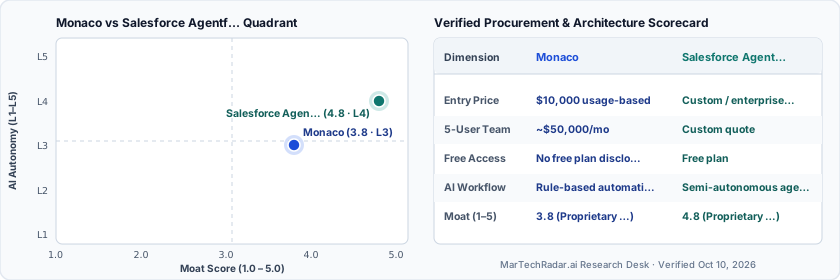
How Monaco and Salesforce Agentforce differ
- Monaco is listed under Autonomous Marketing Agents & Digital Coworkers; Salesforce Agentforce under Enterprise Marketing OS & Ecosystem Agents.
- Pricing model: Monaco is usage-based, Salesforce Agentforce is enterprise / quote.
- Salesforce Agentforce has a free plan; none is recorded for Monaco.
- AI autonomy: Salesforce Agentforce is rated L4 · Autonomous agent, Monaco L3 · Conditional automation on the MarTechRadar scale.
- Moat tier: Salesforce Agentforce is rated Proprietary moat (category leader), Monaco Proprietary moat.
- Salesforce Agentforce was founded earlier (1999) than Monaco (2024).
- Headquarters: Monaco in San Francisco, California, Salesforce Agentforce in San Francisco, United States.
- Funding stage: Monaco is Series B; Salesforce Agentforce is Public company.
- Audience: Monaco targets GTM Operations Teams, Enterprise Marketing Executives, Automated Ops Teams; Salesforce Agentforce targets B2B SaaS, DTC / eCommerce, Enterprise Brands.
- Ecosystem stack: Monaco connects with Outreach, Twilio Segment; Salesforce Agentforce connects with HubSpot, Twilio Segment.
Computed from the fields below. Only editor-verified ratings and vendor-sourced prices are compared.
When to choose Monaco vs Salesforce Agentforce (and when to walk away)
Choose Monaco if
- Target ICP & Stack Fit: You operate as GTM Operations Teams, Enterprise Marketing Executives and Automated Ops Teams requiring a Web SaaS deployment for AI Marketing Agent, with verified ecosystem connectivity for Outreach, Twilio Segment.
- L3 Architecture & Defensibility: Defensibility rests on proprietary task decomposition state machines and agent execution loops that link market research, prospect verification, and dynamic message generation directly into usage-based billing telemetry.
- Commercial Model Fit: Your procurement budget aligns with $10,000 usage-based.
Walk away from Monaco if
- Walk away if your team is at early validation stage with a <$250/mo tool budget (Monaco starts at $10,000 usage-based before seat or usage expansion).
- Walk away if your workflow cannot tolerate mailbox deliverability thresholds: Automated outbound cadence requires external mailbox warming and strict IP monitoring; rapid volume scaling triggers domain reputation penalties from corporate spam filters.
- Walk away if complex buyer attribution is a deal-breaker for your team: Autonomous research agents struggle to resolve enterprise committee hierarchies, often misidentifying economic buyers in complex multi-stakeholder organizational structures.
Choose Salesforce Agentforce if
- Target ICP & Stack Fit: You operate as B2B SaaS, DTC / eCommerce and Enterprise Brands requiring a Web SaaS deployment for Enterprise AI Marketing, with verified ecosystem connectivity for HubSpot, Twilio Segment.
- L4 Architecture & Defensibility: Deep integration with the proprietary Salesforce metadata architecture, unified Data Cloud access, and the Atlas Reasoning Engine providing grounded multi-step workflow execution.
- Commercial Model Fit: Your procurement budget aligns with Custom / enterprise pricing and want a self-serve free tier for zero-cost initial validation.
Walk away from Salesforce Agentforce if
- Walk away if you require transparent self-serve monthly billing or your budget ceiling is under $1,000/mo (Salesforce Agentforce requires sales-gated custom quoting).
- Walk away if your workflow cannot tolerate data cloud schema dependency: Agent accuracy and execution reliability degrade when enterprise data is fragmented outside Salesforce Data Cloud or lacks rigorous entity resolution.
- Walk away if action boundary drift is a deal-breaker for your team: Orchestrating autonomous logic through complex custom Flows requires exhaustive guardrail configuration to prevent unwanted updates across production transactional records.
Side-by-side facts
| Field | Monaco | Salesforce Agentforce |
|---|---|---|
| Subtrack | Autonomous Marketing Agents & Digital Coworkers | Enterprise Marketing OS & Ecosystem Agents |
| Pricing | $10,000 usage-based | Custom / enterprise pricing |
| Pricing model | Usage-based | Enterprise / quote |
| Published pricing tiers | — | Free / Sandbox ($0) · Enterprise / Custom (Custom quote) |
| Free access | No free plan disclosed | Free plan |
| Enterprise plan | Not recorded | Yes |
| AI autonomy level | L3 · Conditional automation | L4 · Autonomous agent |
| Moat tier & score | 3.8 / 5.0 · Proprietary moat | 4.8 / 5.0 · Proprietary moat (category leader) |
| Delivery | Web SaaS | Web SaaS |
| Audience | GTM Operations Teams, Enterprise Marketing Executives, Automated Ops Teams | B2B SaaS, DTC / eCommerce, Enterprise Brands |
| Ecosystem integrations | Outreach, Twilio Segment | HubSpot, Twilio Segment |
| Funding & backing | $85M · Backed by Founders Fund, Human Capital, Benchmark | Public company |
| Founders | Abishek Viswanathan, Brian Blond, Malay Desai, Sam Blond | — |
| Company size | 11-50 employees | — |
| Founded | 2024 | 1999 |
| Headquarters | San Francisco, California | San Francisco, United States |
| Fact-checked | MarTechRadar Research Desk, Oct 10, 2026 | MarTechRadar Research Desk, Oct 7, 2026 |
| Governance & docs | Trust & Security ↗ · System Status ↗ · Terms ↗ · Privacy ↗ | Privacy ↗ |
Monaco vs Salesforce Agentforce: TCO & constraint stress test
Test how both tools behave under your team size, monthly budget ceiling, CRM ecosystem, and governance guardrails.
Monaco
High Deal-Risk · Constraint Mismatch- Budget Ceiling Breached ($50,000/mo vs. $800/mo cap): At 5 seats, Monaco's verified entry floor ($10,000 usage-based) exceeds your $800/mo budget before add-ons or overages.
- Published Self-Serve Entry Floor: Monaco publishes a transparent entry point ($10,000 usage-based) for initial validation before committing.
- Usage / Credit Burn Volatility: Monaco uses credit or usage-metered billing ($10,000 usage-based). High-volume automated workflows across 5 seats can trigger mid-cycle overage charges.
- Primary Operational Bottleneck: Mailbox Deliverability Thresholds: Automated outbound cadence requires external mailbox warming and strict IP monitoring; rapid volume scaling triggers domain reputation penalties from corporate spam filters.
Walk-Away Rule: Walk away if your team is at early validation stage with a <$250/mo tool budget (Monaco starts at $10,000 usage-based before seat or usage expansion).
Negotiation Lever: Negotiate price-lock protection on additional seats and overage credits above the $10,000 usage-based entry tier.
Salesforce Agentforce
Conditional Fit · Contract & Stack Caveats- Opaque Enterprise Quoting vs. SMB/Mid-Market Budget: Salesforce Agentforce does not disclose a public self-serve floor (Custom / enterprise pricing). Buyers with a $800/mo cap face high sales-qualification friction.
- Published Self-Serve Entry Floor: Salesforce Agentforce publishes a transparent entry point (Custom / enterprise pricing) with a free tier for initial validation before committing.
- Primary Operational Bottleneck: Data Cloud Schema Dependency: Agent accuracy and execution reliability degrade when enterprise data is fragmented outside Salesforce Data Cloud or lacks rigorous entity resolution.
Walk-Away Rule: Walk away if you require transparent self-serve monthly billing or your budget ceiling is under $1,000/mo (Salesforce Agentforce requires sales-gated custom quoting).
Negotiation Lever: Demand a 30- to 60-day paid pilot opt-out clause in the Salesforce Agentforce order form before signing a 12-month enterprise commitment.
Limitations
Monaco
Operational considerations and platform boundaries include: Mailbox Deliverability Thresholds: Automated outbound cadence requires external mailbox warming and strict IP monitoring; rapid volume scaling triggers domain reputation penalties from corporate spam filters.Full limitations in the Monaco review
Salesforce Agentforce
Operational considerations and platform boundaries include: Data Cloud Schema Dependency: Agent accuracy and execution reliability degrade when enterprise data is fragmented outside Salesforce Data Cloud or lacks rigorous entity resolution.Full limitations in the Salesforce Agentforce review
Official vendor architectural differentiators & migration proof
To help buyers evaluate real-world switching costs, verified founders, solutions architects, and PMMs at both Monaco and Salesforce Agentforce can submit up to 3 evidence-backed architectural differentiators or verified customer migration case studies.
Why teams choose Monaco over Salesforce Agentforce
Work at Monaco? Verify your official domain email to publish 3 technical differentiators, migration benchmarks, or a head-to-head buyer sandbox offer on this comparison page:
+ Submit Monaco Official Differentiators & Case Study →Why teams choose Salesforce Agentforce over Monaco
Work at Salesforce Agentforce? Verify your official domain email to publish 3 technical differentiators, migration benchmarks, or a head-to-head buyer sandbox offer on this comparison page:
+ Submit Salesforce Agentforce Official Differentiators & Case Study →Pricing notes & tier schedules
Monaco: $10,000 usage-based
Monaco rejects per-seat licensing in favor of a consumption framework requiring a $10,000 upfront commit. This deposit converts directly into usage credits that deduct as agents execute research and messaging jobs.
- Credit & Usage Burn Multiplier: Workflows on Monaco consume metered credits or usage quotas; multi-provider enrichment lookups, scraping runs, or bulk batch jobs can exhaust base allocations and trigger mid-cycle top-up packs.
- Mailbox Deliverability Thresholds: Automated outbound cadence requires external mailbox warming and strict IP monitoring; rapid volume scaling triggers domain reputation penalties from corporate spam filters.
Salesforce Agentforce: Custom / enterprise pricing
Salesforce provides an entry tier starting at $0 for initial evaluation via foundation tiers, alongside custom enterprise plans governed by consumption units such as conversations or flex credits.
- Free / Sandbox ($0, 1–2 seats (Evaluation)): Entry free tier with capped usage or feature quotas for initial workflow testing.
- Enterprise / Custom (Custom quote, 15–50+ seats (Enterprise SLA)): Sales-negotiated annual contract for custom volume, SSO/RBAC governance, and dedicated SLA.
- Credit & Usage Burn Multiplier: Workflows on Salesforce Agentforce consume metered credits or usage quotas; voice/media minutes, multi-step synthesis, or high-frequency runs can exhaust base allocations and trigger mid-cycle top-up packs.
- Enterprise Governance & Add-On Gating: Advanced capabilities such as Single Sign-On (SSO), custom role permissions, or specialized analytics modules are gated behind upper tiers or paid add-ons.
Frequently asked questions: Monaco vs Salesforce Agentforce
How does Monaco pricing compare to Salesforce Agentforce in 2026?
Monaco is listed at $10,000 usage-based (usage-based, no free plan disclosed), whereas Salesforce Agentforce is listed at Custom / enterprise pricing (enterprise / quote, free plan).
How do Monaco and Salesforce Agentforce compare on AI autonomy and moat depth?
On the MarTechRadar L1–L5 scale, Monaco is rated L3 · Conditional automation with a Proprietary moat moat (3.8/5.0), while Salesforce Agentforce is rated L4 · Autonomous agent with a Proprietary moat (category leader) moat (4.8/5.0).
Which teams are Monaco and Salesforce Agentforce built for?
Monaco is a Web SaaS product in Autonomous Marketing Agents & Digital Coworkers designed for GTM Operations Teams, Enterprise Marketing Executives, Automated Ops Teams. Salesforce Agentforce is a Web SaaS product in Enterprise Marketing OS & Ecosystem Agents designed for B2B SaaS, DTC / eCommerce, Enterprise Brands.
What are the main limitations of Monaco vs Salesforce Agentforce?
For Monaco: Operational considerations and platform boundaries include: Mailbox Deliverability Thresholds: Automated outbound cadence requires external mailbox warming and strict IP monitoring; rapid volume scaling triggers domain reputation penalties from corporate spam filters. For Salesforce Agentforce: Operational considerations and platform boundaries include: Data Cloud Schema Dependency: Agent accuracy and execution reliability degrade when enterprise data is fragmented outside Salesforce Data Cloud or lacks rigorous entity resolution.
What are the hidden TCO drivers and contract negotiation levers for Monaco vs Salesforce Agentforce?
For Monaco: Credit & Usage Burn Multiplier (Workflows on Monaco consume metered credits or usage quotas; multi-provider enrichment lookups, scraping runs, or bulk batch jobs can exhaust base allocations and trigger mid-cycle top-up packs.) Negotiation lever: Negotiate price-lock protection on additional seats and overage credits above the $10,000 usage-based entry tier. For Salesforce Agentforce: Credit & Usage Burn Multiplier (Workflows on Salesforce Agentforce consume metered credits or usage quotas; voice/media minutes, multi-step synthesis, or high-frequency runs can exhaust base allocations and trigger mid-cycle top-up packs.) Negotiation lever: Demand a 30- to 60-day paid pilot opt-out clause in the Salesforce Agentforce order form before signing a 12-month enterprise commitment.
Excerpts are quoted verbatim from each fact-checked review. Last updated Oct 10, 2026.