Fluency vs FLUX
Reviewed by MarTechRadar Research Desk. Pricing & entity snapshots verified Oct 12, 2026.
Fluency (Web SaaS) and FLUX (Web SaaS) both compete in Dynamic Creative Optimization / DCO. On pricing, Fluency lists Custom / enterprise pricing (no free plan disclosed), whereas FLUX lists Custom / enterprise pricing (no free plan disclosed). Technically, Fluency is rated L4 · Autonomous agent with a 3.9/5.0 (Proprietary moat) moat, while FLUX is rated L3 · Conditional automation with a 4.2/5.0 (Proprietary moat) moat. Corporate profile: Fluency (founded 2017, HQ Burlington, Vermont, $41M funding) vs. FLUX (founded 2018, HQ Tokyo, Japan, ¥16B funding). Verified by the MarTechRadar Research Desk (Oct 6, 2026 for Fluency; Oct 12, 2026 for FLUX). At a 5-seat team baseline, Fluency starts at Custom quote vs FLUX at Custom quote.
Fluency
Agentic advertising operations platform that automates campaign creation, budget optimization, and multi-channel creative distribution for scaled agencies.
5-User Team Cost: Custom quote (Custom / enterprise pricing) · Autonomy: L4 · Autonomous agent · Moat: 3.9/5.0 (Proprietary moat)
Target fit: DTC / eCommerce, Enterprise Brands (Web SaaS)
FLUX
Enterprise dynamic creative optimization and monetization platform orchestrating algorithmic ad variations, automated bid evaluation, and marketing.
5-User Team Cost: Custom quote (Custom / enterprise pricing) · Autonomy: L3 · Conditional automation · Moat: 4.2/5.0 (Proprietary moat)
Target fit: Performance Marketing Directors, Ad Agencies, Retail Media Advertisers (Web SaaS)
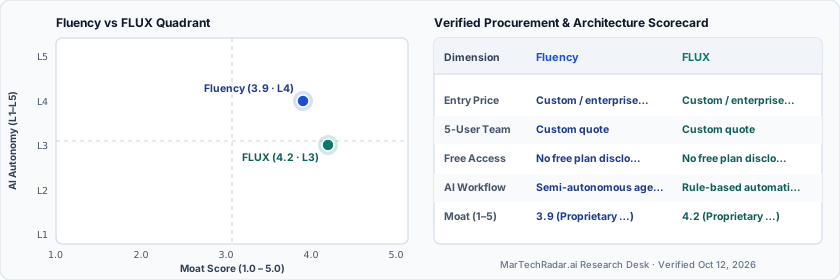
How Fluency and FLUX differ
- AI autonomy: Fluency is rated L4 · Autonomous agent, FLUX L3 · Conditional automation on the MarTechRadar scale.
- Moat score: FLUX scores 4.2/5.0 vs. Fluency at 3.9/5.0 (Proprietary moat).
- Fluency was founded earlier (2017) than FLUX (2018).
- Headquarters: Fluency in Burlington, Vermont, FLUX in Tokyo, Japan.
- Verified backing: Fluency records $41M (Undisclosed Investors); FLUX records ¥16B (Salesforce Ventures).
- Company headcount: Fluency is 51-200 employees; FLUX is 501-1,000 employees.
- Audience: Fluency targets DTC / eCommerce, Enterprise Brands; FLUX targets Performance Marketing Directors, Ad Agencies, Retail Media Advertisers.
- Ecosystem stack: Fluency connects with Google Ads; FLUX connects with Twilio Segment, Notion.
Computed from the fields below. Only editor-verified ratings and vendor-sourced prices are compared.
When to choose Fluency vs FLUX (and when to walk away)
Choose Fluency if
- Target ICP & Stack Fit: You operate as DTC / eCommerce and Enterprise Brands requiring a Web SaaS deployment for DCO, with verified ecosystem connectivity for Google Ads.
- L4 Architecture & Defensibility: Proprietary robotic process automation engine capable of programmatic execution across disparate ad networks, purpose-built blueprint architectures for multi-location campaigns, and early-mover enterprise agency lock-in.
- Commercial Model Fit: Your procurement budget aligns with Custom / enterprise pricing.
Walk away from Fluency if
- Walk away if you require transparent self-serve monthly billing or your budget ceiling is under $1,000/mo (Fluency requires sales-gated custom quoting).
- Walk away if your workflow cannot tolerate API rate limits and ad network latency: Executing continuous automated updates across thousands of multi-location ad accounts exposes operations to publisher API call quotas and asynchronous review delays.
- Walk away if product catalog schema brittleness is a deal-breaker for your team: Dynamic creative generation depends heavily on pristine inventory data feeds, where unmapped attributes or sudden field taxonomy shifts disrupt creative assembly.
Choose FLUX if
- Target ICP & Stack Fit: You operate as Performance Marketing Directors, Ad Agencies and Retail Media Advertisers requiring a Web SaaS deployment for DCO, with verified ecosystem connectivity for Twilio Segment, Notion.
- L3 Architecture & Defensibility: FLUX establishes defensibility via deep regional publisher integrations, proprietary multi-armed bandit creative allocation algorithms, and institutional capital backing that cements significant market share across enterprise Japanese programmatic ecosystems.
- Commercial Model Fit: Your procurement budget aligns with Custom / enterprise pricing.
Walk away from FLUX if
- Walk away if you require transparent self-serve monthly billing or your budget ceiling is under $1,000/mo (FLUX requires sales-gated custom quoting).
- Walk away if your workflow cannot tolerate regional schema dependencies: The algorithmic taxonomy and data ingestion connectors are heavily anchored to Japanese digital ecosystems, demanding custom data restructuring when integrating Western enterprise marketing stacks.
- Walk away if catalog latency and sync drift is a deal-breaker for your team: Rapid variations in high-throughput ecommerce inventories risk downstream delivery lag across programmatic ad servers if source feeds exceed platform batch indexing intervals.
Side-by-side facts
| Field | Fluency | FLUX |
|---|---|---|
| Subtrack | Dynamic Creative Optimization / DCO | Dynamic Creative Optimization / DCO |
| Pricing | Custom / enterprise pricing | Custom / enterprise pricing |
| Pricing model | Enterprise / quote | Enterprise / quote |
| Published pricing tiers | Enterprise / Custom (Custom quote) | Enterprise / Custom (Custom quote) |
| Free access | No free plan disclosed | No free plan disclosed |
| Enterprise plan | Yes | Yes |
| AI autonomy level | L4 · Autonomous agent | L3 · Conditional automation |
| Moat tier & score | 3.9 / 5.0 · Proprietary moat | 4.2 / 5.0 · Proprietary moat |
| Delivery | Web SaaS | Web SaaS |
| Audience | DTC / eCommerce, Enterprise Brands | Performance Marketing Directors, Ad Agencies, Retail Media Advertisers |
| Ecosystem integrations | Google Ads | Twilio Segment, Notion |
| Compliance & governance | — | ISO 27001 |
| Funding & backing | $41M · Backed by Undisclosed Investors | ¥16B · Backed by Salesforce Ventures |
| Founders | Brian McVey, Eric Mayhew, Michael Lane, Scott Gale | Genji Nagai, Shinnosuke Hirata |
| Company size | 51-200 employees | 501-1,000 employees |
| Founded | 2017 | 2018 |
| Headquarters | Burlington, Vermont | Tokyo, Japan |
| Fact-checked | MarTechRadar Research Desk, Oct 6, 2026 | MarTechRadar Research Desk, Oct 12, 2026 |
| Governance & docs | Trust & Security ↗ · Privacy ↗ | Trust & Security ↗ |
Fluency vs FLUX: TCO & constraint stress test
Test how both tools behave under your team size, monthly budget ceiling, CRM ecosystem, and governance guardrails.
Fluency
High Deal-Risk · Constraint Mismatch- Opaque Enterprise Quoting vs. SMB/Mid-Market Budget: Fluency does not disclose a public self-serve floor (Custom / enterprise pricing). Buyers with a $800/mo cap face high sales-qualification friction.
- Sales-Gated Contract Terms: Commercial pricing is available on request through tailored enterprise sales quotes based on organizational scale and seats.
- Primary Operational Bottleneck: API Rate Limits and Ad Network Latency: Executing continuous automated updates across thousands of multi-location ad accounts exposes operations to publisher API call quotas and asynchronous review delays.
Walk-Away Rule: Walk away if you require transparent self-serve monthly billing or your budget ceiling is under $1,000/mo (Fluency requires sales-gated custom quoting).
Negotiation Lever: Demand a 30- to 60-day paid pilot opt-out clause in the Fluency order form before signing a 12-month enterprise commitment.
FLUX
High Deal-Risk · Constraint Mismatch- Opaque Enterprise Quoting vs. SMB/Mid-Market Budget: FLUX does not disclose a public self-serve floor (Custom / enterprise pricing). Buyers with a $800/mo cap face high sales-qualification friction.
- Sales-Gated Contract Terms: FLUX provides commercial pricing available on request through tailored enterprise sales quotes based on organizational scale and seats.
- Primary Operational Bottleneck: Regional Schema Dependencies: The algorithmic taxonomy and data ingestion connectors are heavily anchored to Japanese digital ecosystems, demanding custom data restructuring when integrating Western enterprise marketing stacks.
Walk-Away Rule: Walk away if you require transparent self-serve monthly billing or your budget ceiling is under $1,000/mo (FLUX requires sales-gated custom quoting).
Negotiation Lever: Demand a 30- to 60-day paid pilot opt-out clause in the FLUX order form before signing a 12-month enterprise commitment.
Limitations
Fluency
Operational considerations and platform boundaries include: API Rate Limits and Ad Network Latency: Executing continuous automated updates across thousands of multi-location ad accounts exposes operations to publisher API call quotas and asynchronous review delays.Full limitations in the Fluency review
FLUX
Operational considerations and platform boundaries include: Regional Schema Dependencies: The algorithmic taxonomy and data ingestion connectors are heavily anchored to Japanese digital ecosystems, demanding custom data restructuring when integrating Western enterprise marketing stacks.Full limitations in the FLUX review
Official vendor architectural differentiators & migration proof
To help buyers evaluate real-world switching costs, verified founders, solutions architects, and PMMs at both Fluency and FLUX can submit up to 3 evidence-backed architectural differentiators or verified customer migration case studies.
Why teams choose Fluency over FLUX
Work at Fluency? Verify your official domain email to publish 3 technical differentiators, migration benchmarks, or a head-to-head buyer sandbox offer on this comparison page:
+ Submit Fluency Official Differentiators & Case Study →Why teams choose FLUX over Fluency
Work at FLUX? Verify your official domain email to publish 3 technical differentiators, migration benchmarks, or a head-to-head buyer sandbox offer on this comparison page:
+ Submit FLUX Official Differentiators & Case Study →Pricing notes & tier schedules
Fluency: Custom / enterprise pricing
Commercial pricing is available on request through tailored enterprise sales quotes based on organizational scale and seats. Fluency licenses its software under customized annual software agreements scaled by media portfolio size, account volume, and deployment scope across in-house or agency teams.
- Enterprise / Custom (Custom quote, 15–50+ seats (Enterprise SLA)): Sales-negotiated annual contract for custom volume, SSO/RBAC governance, and dedicated SLA.
- API Rate Limits and Ad Network Latency: Executing continuous automated updates across thousands of multi-location ad accounts exposes operations to publisher API call quotas and asynchronous review delays.
- Product Catalog Schema Brittleness: Dynamic creative generation depends heavily on pristine inventory data feeds, where unmapped attributes or sudden field taxonomy shifts disrupt creative assembly.
FLUX: Custom / enterprise pricing
FLUX provides commercial pricing available on request through tailored enterprise sales quotes based on organizational scale and seats.
- Enterprise / Custom (Custom quote, 15–50+ seats (Enterprise SLA)): Sales-negotiated annual contract for custom volume, SSO/RBAC governance, and dedicated SLA.
- Regional Schema Dependencies: The algorithmic taxonomy and data ingestion connectors are heavily anchored to Japanese digital ecosystems, demanding custom data restructuring when integrating Western enterprise marketing stacks.
- Catalog Latency and Sync Drift: Rapid variations in high-throughput ecommerce inventories risk downstream delivery lag across programmatic ad servers if source feeds exceed platform batch indexing intervals.
Frequently asked questions: Fluency vs FLUX
How does Fluency pricing compare to FLUX in 2026?
Fluency is listed at Custom / enterprise pricing (enterprise / quote, no free plan disclosed), whereas FLUX is listed at Custom / enterprise pricing (enterprise / quote, no free plan disclosed).
How do Fluency and FLUX compare on AI autonomy and moat depth?
On the MarTechRadar L1–L5 scale, Fluency is rated L4 · Autonomous agent with a Proprietary moat moat (3.9/5.0), while FLUX is rated L3 · Conditional automation with a Proprietary moat moat (4.2/5.0).
Which teams are Fluency and FLUX built for?
Fluency is a Web SaaS product in Dynamic Creative Optimization / DCO designed for DTC / eCommerce, Enterprise Brands. FLUX is a Web SaaS product in Dynamic Creative Optimization / DCO designed for Performance Marketing Directors, Ad Agencies, Retail Media Advertisers.
What are the main limitations of Fluency vs FLUX?
For Fluency: Operational considerations and platform boundaries include: API Rate Limits and Ad Network Latency: Executing continuous automated updates across thousands of multi-location ad accounts exposes operations to publisher API call quotas and asynchronous review delays. For FLUX: Operational considerations and platform boundaries include: Regional Schema Dependencies: The algorithmic taxonomy and data ingestion connectors are heavily anchored to Japanese digital ecosystems, demanding custom data restructuring when integrating Western enterprise marketing stacks.
What are the hidden TCO drivers and contract negotiation levers for Fluency vs FLUX?
For Fluency: API Rate Limits and Ad Network Latency (Executing continuous automated updates across thousands of multi-location ad accounts exposes operations to publisher API call quotas and asynchronous review delays.) Negotiation lever: Demand a 30- to 60-day paid pilot opt-out clause in the Fluency order form before signing a 12-month enterprise commitment. For FLUX: Regional Schema Dependencies (The algorithmic taxonomy and data ingestion connectors are heavily anchored to Japanese digital ecosystems, demanding custom data restructuring when integrating Western enterprise marketing stacks.) Negotiation lever: Demand a 30- to 60-day paid pilot opt-out clause in the FLUX order form before signing a 12-month enterprise commitment.
Excerpts are quoted verbatim from each fact-checked review. Last updated Oct 12, 2026.