Customer.io AI vs WATI
Reviewed by MarTechRadar Research Desk. Pricing & entity snapshots verified Oct 12, 2026.
Customer.io AI (Web SaaS, AI Email Marketing & Lifecycle Journeys) and WATI (Web SaaS, Conversational eCommerce & Support Bots) address adjacent GTM workflows. On pricing, Customer.io AI lists From $100/mo (no free plan disclosed), whereas WATI lists $59–$279/mo (no free plan disclosed). Technically, Customer.io AI is rated L3 · Conditional automation with a 4.1/5.0 (Proprietary moat) moat, while WATI is rated L3 · Conditional automation with a 4.1/5.0 (Proprietary moat) moat. Corporate profile: Customer.io AI (founded 2012, HQ Portland, Oregon, $10.9M funding) vs. WATI (founded 2020, HQ Kuala Lumpur, $31.3M funding). Verified by the MarTechRadar Research Desk (Oct 12, 2026 for Customer.io AI; Oct 11, 2026 for WATI). At a 5-seat team baseline, Customer.io AI starts at ~$100/mo (base) vs WATI at $119/mo.
Customer.io AI
Behavioral messaging and customer engagement platform orchestrating event-driven lifecycle communications via email, push, and SMS.
5-User Team Cost: ~$100/mo (base) (From $100/mo) · Autonomy: L3 · Conditional automation · Moat: 4.1/5.0 (Proprietary moat)
Target fit: B2B SaaS, DTC / eCommerce, Enterprise Brands (Web SaaS)
WATI
Conversational customer engagement and marketing automation platform built on messaging APIs for omnichannel direct customer communication.
5-Seat Floor: $119/mo ($59–$279/mo) · Autonomy: L3 · Conditional automation · Moat: 4.1/5.0 (Proprietary moat)
Target fit: CRM & Lifecycle Marketers, eCommerce Growth Teams, Customer Experience Directors (Web SaaS)
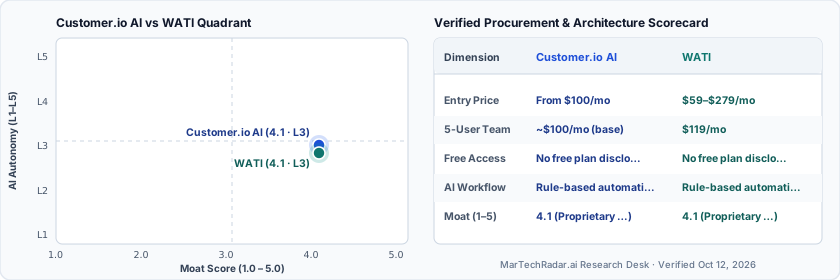
How Customer.io AI and WATI differ
- Customer.io AI is listed under AI Email Marketing & Lifecycle Journeys; WATI under Conversational eCommerce & Support Bots.
- Entry price: WATI starts lower ($59–$279/mo) than Customer.io AI (From $100/mo).
- Published tier ladder: Customer.io AI documents 1 priced tier (Essentials $100/mo); WATI documents 3 priced tiers (Growth $59/mo, Pro $119/mo, Business $279/mo).
- Customer.io AI was founded earlier (2012) than WATI (2020).
- Headquarters: Customer.io AI in Portland, Oregon, WATI in Kuala Lumpur.
- Verified backing: Customer.io AI records $10.9M (Oregon Venture Fund); WATI records $31.3M (Sequoia Capital, Peak XV Partners).
- Audience: Customer.io AI targets B2B SaaS, DTC / eCommerce, Enterprise Brands; WATI targets CRM & Lifecycle Marketers, eCommerce Growth Teams, Customer Experience Directors.
- Ecosystem stack: Customer.io AI connects with Slack, Twilio Segment, Notion; WATI connects with Salesforce, HubSpot, Shopify, Twilio Segment.
Computed from the fields below. Only editor-verified ratings and vendor-sourced prices are compared.
When to choose Customer.io AI vs WATI (and when to walk away)
Choose Customer.io AI if
- Target ICP & Stack Fit: You operate as B2B SaaS, DTC / eCommerce and Enterprise Brands requiring a Web SaaS deployment for Email Marketing, with verified ecosystem connectivity for Slack, Twilio Segment, Notion.
- L3 Architecture & Defensibility: Robust real-time event processing architecture paired with deep behavioral data pipelining that bridges product telemetry with multi-channel messaging logic.
- Commercial Model Fit: Your procurement budget aligns with From $100/mo.
Walk away from Customer.io AI if
- Walk away if your workflow requires uncapped enterprise volume on the From $100/mo entry plan without upgrading tiers.
- Walk away if your workflow cannot tolerate payload schema rigidity: Event payloads must adhere strictly to predefined JSON structures, as malformed schemas or type mismatches silently drop attributes without self-healing fallback mechanisms.
- Walk away if ingestion rate throttling is a deal-breaker for your team: High-velocity data spikes during promotional events risk hitting API rate limits, which induces queue latency across downstream trigger execution windows.
Choose WATI if
- Target ICP & Stack Fit: You operate as CRM & Lifecycle Marketers, eCommerce Growth Teams and Customer Experience Directors requiring a Web SaaS deployment for eCommerce Chatbot, with verified ecosystem connectivity for Salesforce, HubSpot, Shopify, Twilio Segment.
- L3 Architecture & Defensibility: Direct official WhatsApp Business Solution Provider infrastructure paired with localized SMB distribution networks and multi-agent inbox tooling across high-volume chat regions.
- Commercial Model Fit: Your procurement budget aligns with $59–$279/mo.
Walk away from WATI if
- Walk away if your workflow requires uncapped enterprise volume on the $59–$279/mo entry plan without upgrading tiers.
- Walk away if your workflow cannot tolerate API rate limits and template approval latency: Message dispatch depends strictly on Meta business verification rules, rate tiers, and pre-approved template schemas, which restricts immediate iterative broadcast experiments.
- Walk away if complex relational data constraints is a deal-breaker for your team: Data models rely on flat contact attributes rather than deep event streams, creating operational overhead when synchronizing high-cardinality multi-table schemas from external data warehouses.
Side-by-side facts
| Field | Customer.io AI | WATI |
|---|---|---|
| Subtrack | AI Email Marketing & Lifecycle Journeys | Conversational eCommerce & Support Bots |
| Pricing | From $100/mo | $59–$279/mo |
| Pricing model | Subscription | Subscription |
| Published pricing tiers | Essentials ($100/mo) | Growth ($59/mo) · Pro ($119/mo) · Business ($279/mo) |
| Free access | No free plan disclosed | No free plan disclosed |
| Enterprise plan | Not recorded | Not recorded |
| AI autonomy level | L3 · Conditional automation | L3 · Conditional automation |
| Moat tier & score | 4.1 / 5.0 · Proprietary moat | 4.1 / 5.0 · Proprietary moat |
| Delivery | Web SaaS | Web SaaS |
| Audience | B2B SaaS, DTC / eCommerce, Enterprise Brands | CRM & Lifecycle Marketers, eCommerce Growth Teams, Customer Experience Directors |
| Ecosystem integrations | Slack, Twilio Segment, Notion | Salesforce, HubSpot, Shopify, Twilio Segment, Zapier |
| Compliance & governance | GDPR, HIPAA | GDPR, CCPA |
| Funding & backing | $10.9M · Backed by Oregon Venture Fund | $31.3M · Backed by Sequoia Capital, Peak XV Partners |
| Founders | Colin Nederkoorn, John Allison | Bianca Ho, Ken Yeung |
| Company size | 201-500 employees | 201-500 employees |
| Founded | 2012 | 2020 |
| Headquarters | Portland, Oregon | Kuala Lumpur |
| Fact-checked | MarTechRadar Research Desk, Oct 12, 2026 | MarTechRadar Research Desk, Oct 11, 2026 |
| Governance & docs | Trust & Security ↗ · API & Docs ↗ · Privacy ↗ | Trust & Security ↗ · API & Docs ↗ · Privacy ↗ |
Customer.io AI vs WATI: TCO & constraint stress test
Test how both tools behave under your team size, monthly budget ceiling, CRM ecosystem, and governance guardrails.
Customer.io AI
Low Procurement Risk · Strong Fit- Published Self-Serve Entry Floor: Customer.io AI publishes a transparent entry point (From $100/mo) for initial validation before committing.
- Primary Operational Bottleneck: Workspace Data Isolation: Multi-brand or staging architectures face strict workspace boundaries that prevent cross-environment profile synchronization without custom middle-tier pipeline engineering.
Walk-Away Rule: Walk away if your workflow requires uncapped enterprise volume on the From $100/mo entry plan without upgrading tiers.
Negotiation Lever: Validate exact quota thresholds (seats, credits, or API calls) included in Customer.io AI's From $100/mo tier before converting from monthly to annual billing.
WATI
Low Procurement Risk · Strong Fit- Published Self-Serve Entry Floor: WATI publishes a transparent entry point ($59–$279/mo) for initial validation before committing.
- Linear Per-Seat Scaling (5 Seats × $59/seat/mo): Base license scales linearly with operator headcount ($295/mo for 5 seats on Growth).
- Primary Operational Bottleneck: API Rate Limits and Template Approval Latency: Message dispatch depends strictly on Meta business verification rules, rate tiers, and pre-approved template schemas, which restricts immediate iterative broadcast experiments.
Walk-Away Rule: Walk away if your workflow requires uncapped enterprise volume on the $59–$279/mo entry plan without upgrading tiers.
Negotiation Lever: Validate exact quota thresholds (seats, credits, or API calls) included in WATI's $59–$279/mo tier before converting from monthly to annual billing.
Limitations
Customer.io AI
Operational considerations and platform boundaries include: Payload Schema Rigidity: Event payloads must adhere strictly to predefined JSON structures, as malformed schemas or type mismatches silently drop attributes without self-healing fallback mechanisms.Full limitations in the Customer.io AI review
WATI
Operational considerations and platform boundaries include: API Rate Limits and Template Approval Latency: Message dispatch depends strictly on Meta business verification rules, rate tiers, and pre-approved template schemas, which restricts immediate iterative broadcast experiments.Full limitations in the WATI review
Official vendor architectural differentiators & migration proof
To help buyers evaluate real-world switching costs, verified founders, solutions architects, and PMMs at both Customer.io AI and WATI can submit up to 3 evidence-backed architectural differentiators or verified customer migration case studies.
Why teams choose Customer.io AI over WATI
Work at Customer.io AI? Verify your official domain email to publish 3 technical differentiators, migration benchmarks, or a head-to-head buyer sandbox offer on this comparison page:
+ Submit Customer.io AI Official Differentiators & Case Study →Why teams choose WATI over Customer.io AI
Work at WATI? Verify your official domain email to publish 3 technical differentiators, migration benchmarks, or a head-to-head buyer sandbox offer on this comparison page:
+ Submit WATI Official Differentiators & Case Study →Pricing notes & tier schedules
Customer.io AI: From $100/mo
Customer.io structures its software licensing primarily on stored profile volume alongside outbound message limits. Commercial commitments begin at $100 per month for foundational platform access covering entry-level profile tiers, with monthly costs stepping upward as addressable contact counts scale.
- Essentials ($100/mo, 1–2 seats): per month / billed monthly for
- Payload Schema Rigidity: Event payloads must adhere strictly to predefined JSON structures, as malformed schemas or type mismatches silently drop attributes without self-healing fallback mechanisms.
- Ingestion Rate Throttling: High-velocity data spikes during promotional events risk hitting API rate limits, which induces queue latency across downstream trigger execution windows.
WATI: $59–$279/mo
Commercial access spans published subscription plans from $59 per month through $119 per month on Pro and $279 per month on Business, scaling upward based on assigned agent seats, add-on features, and platform tier allocations.
- Growth ($59/mo, 3 users (hard cap)): 3 users included (no extra seats allowed), 15k broadcasts/mo, 1,000 automation triggers, and 10k API calls/mo.
- Pro ($119/mo, 5 users (+$39/mo/seat)): 5 users included (+$39/user/mo), 2,000 automation triggers, 200k API calls/mo, AI Co-pilot credits, and webhooks.
- Business ($279/mo, 5 users (+$89/mo/seat)): 5 users included (+$89/user/mo), high-volume broadcasts, HubSpot/CRM integrations, IP whitelisting, and dedicated onboarding.
- Annual Billing Headline vs. Monthly Premium: Headline entry rates reflect annual billing commitments; month-to-month flexibility carries a higher effective monthly rate or requires annual prepayment.
- Credit & Usage Burn Multiplier: Workflows on WATI consume metered credits or usage quotas; high-volume AI generation, batch queries, or recurring automation runs can exhaust base allocations and trigger mid-cycle top-up packs.
Frequently asked questions: Customer.io AI vs WATI
How does Customer.io AI pricing compare to WATI in 2026?
Customer.io AI is listed at From $100/mo (subscription, no free plan disclosed), whereas WATI is listed at $59–$279/mo (subscription, no free plan disclosed).
How do Customer.io AI and WATI compare on AI autonomy and moat depth?
On the MarTechRadar L1–L5 scale, Customer.io AI is rated L3 · Conditional automation with a Proprietary moat moat (4.1/5.0), while WATI is rated L3 · Conditional automation with a Proprietary moat moat (4.1/5.0).
Which teams are Customer.io AI and WATI built for?
Customer.io AI is a Web SaaS product in AI Email Marketing & Lifecycle Journeys designed for B2B SaaS, DTC / eCommerce, Enterprise Brands. WATI is a Web SaaS product in Conversational eCommerce & Support Bots designed for CRM & Lifecycle Marketers, eCommerce Growth Teams, Customer Experience Directors.
What are the main limitations of Customer.io AI vs WATI?
For Customer.io AI: Operational considerations and platform boundaries include: Payload Schema Rigidity: Event payloads must adhere strictly to predefined JSON structures, as malformed schemas or type mismatches silently drop attributes without self-healing fallback mechanisms. For WATI: Operational considerations and platform boundaries include: API Rate Limits and Template Approval Latency: Message dispatch depends strictly on Meta business verification rules, rate tiers, and pre-approved template schemas, which restricts immediate iterative broadcast experiments.
What are the hidden TCO drivers and contract negotiation levers for Customer.io AI vs WATI?
For Customer.io AI: Payload Schema Rigidity (Event payloads must adhere strictly to predefined JSON structures, as malformed schemas or type mismatches silently drop attributes without self-healing fallback mechanisms.) Negotiation lever: Validate exact quota thresholds (seats, credits, or API calls) included in Customer.io AI's From $100/mo tier before converting from monthly to annual billing. For WATI: Annual Billing Headline vs. Monthly Premium (Headline entry rates reflect annual billing commitments; month-to-month flexibility carries a higher effective monthly rate or requires annual prepayment.) Negotiation lever: Validate exact quota thresholds (seats, credits, or API calls) included in WATI's $59–$279/mo tier before converting from monthly to annual billing.
Excerpts are quoted verbatim from each fact-checked review. Last updated Oct 12, 2026.